

 English
 русский
 Español
 عربى
عربى Home / News / Industry News / G10 Epoxy Board Manufacturer Finds Flatness Now Determines Supplier Status
Industry News
G10 Epoxy Board Manufacturer Finds Flatness Now Determines Supplier Status
2026-07-10
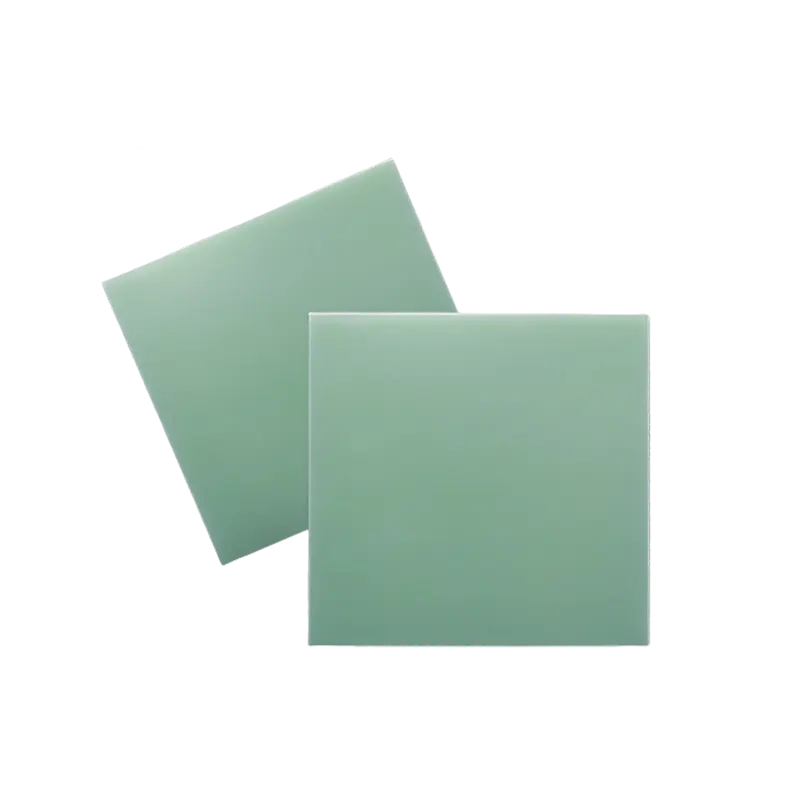
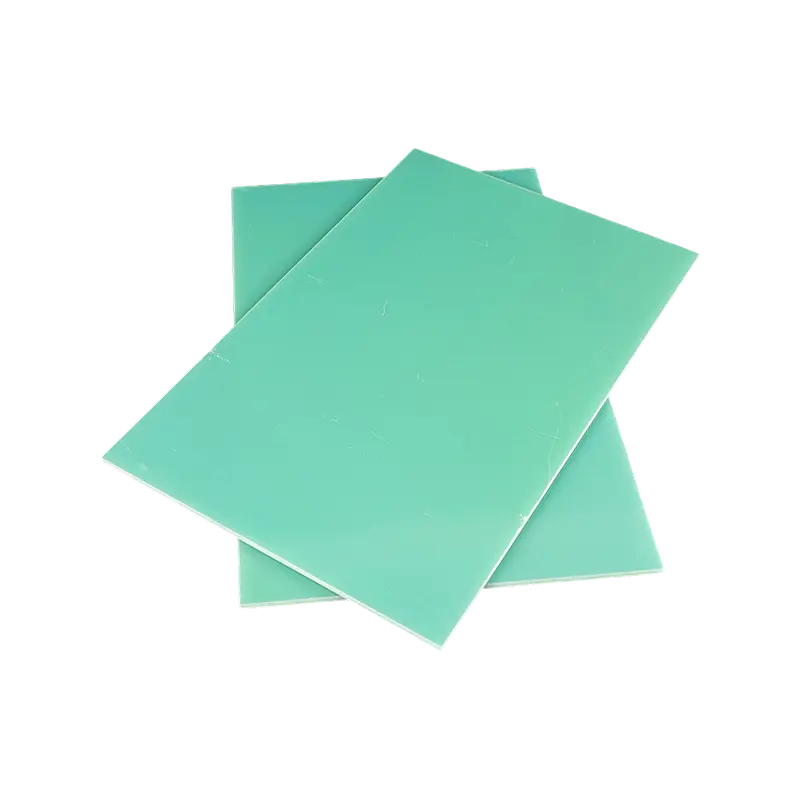
A G10 epoxy board manufacturer that once relied on flame-retardant test results to win contracts now faces a different qualification process. Buyers arrive at factory audits carrying precision straightedges and feeler gauges. They lay the ruler across each panel's diagonal, slide the gauge underneath, and record the gap. Any measurement exceeding 0.15 millimeters sends the entire lot to the rejection pile. The G10 epoxy board manufacturer that cannot control warp through every stage of production—from resin mixing to warehouse storage—loses bids even when its electrical test reports exceed every industry standard. Flatness has become the first filter, and dielectric strength now gets checked only after that filter passes.
The Press Cycle Implants Stresses That Surface Hours Later
Heat and pressure transform stacked layers of glass fabric and epoxy resin into rigid G10 laminate. But the transformation never distributes uniformly across the panel surface. The center reaches cure temperature later than the edges. The resin there experiences a different thermal history, and that difference locks internal stress into the laminate. A G10 epoxy board manufacturer running fast press cycles to improve daily output sees that stress release as warp—not immediately upon demolding, but typically after panels sit stacked for forty-eight hours. The buyer unboxes flat panels, places them on the workbench, and watches the corners lift by the next morning.
Controlling warp requires tracking three press parameters that most production logs ignore:
- The temperature gradient between the upper platen and lower platen, measured at the panel's center rather than at the steam inlet near the edge
- The pressure application point, delayed until the resin viscosity drops below a measured threshold so trapped air escapes before compaction
- The cooling ramp from hold temperature to 100°C, slowed to prevent the surface skin from shrinking faster than the core
A G10 epoxy board manufacturer that records and adjusts these three values for every press load ships panels that stay flat through shipping and storage. One that treats the press cycle as a fixed recipe ships panels that pass final inspection but fail the buyer's incoming check three days later.
Copper Foil Surface Treatment Competes With Glass for Epoxy
Buyers ordering copper-clad G10 for circuit fabrication often specify foil thickness by weight—one ounce or two ounces per square foot. They assume the foil's performance depends on its copper content. In practice, the foil's microscopic surface nodules matter more. Heavily noduled surfaces absorb epoxy away from the glass weave, creating resin-starved zones at the interface. Lightly noduled surfaces allow epoxy to pool, which improves peel adhesion but traps bubbles that later blister under soldering heat.
A G10 epoxy board manufacturer that matches foil nodule density to resin viscosity avoids both problems. The matching decision takes less than a minute using a simple flow-cup test on each mixed resin batch. The consequence of skipping that test takes weeks to surface as delamination complaints from circuit shops that etch away the copper and find voids underneath.
Post-Cure Ovens Separate Stable Boards From Problematic Ones
Panels fresh from the press still carry unreacted epoxy groups. Some manufacturers ship them immediately, assuming that room-temperature aging completes the cross-linking. It does not. The residual reactivity continues for weeks, and the shrinkage accompanying it concentrates unevenly in resin-rich zones. The panel develops a permanent twist that no clamping can correct.
A proper post-cure—four hours at 150°C in a forced-air oven with uniform temperature distribution—completes the cure and drives out residual moisture. The difference shows up in three measurable outcomes:
- Flatness holds within 0.10 millimeters after forty-eight hours of open-air storage
- Drilled hole walls remain clean without smear or fiber pull-out at entry and exit points
- Soldering passes three thermal cycles without blister formation or copper peeling
A G10 epoxy board manufacturer that operates dedicated post-cure ovens with independent zone controllers ships panels that fabricators trust for high-yield production. One that skips post-cure or uses press residual heat as a substitute ships panels that pass initial inspection but generate returns after machining.
Storage Conditions Undo What the Press Built
Even perfectly flat panels warp in storage. Epoxy absorbs atmospheric moisture, and the absorption rate differs between the top surface exposed to circulating air and the bottom surface pressed against a pallet. That differential creates a moisture gradient across the panel thickness. The wetter side expands more than the drier side, and the panel curls. This warp often appears only after the panel reaches the buyer's facility, when the straightedge check happens as part of incoming inspection.
Preventing storage-related warp costs little but requires discipline:
- Climate-controlled warehouses with desiccant dehumidifiers maintain stable humidity below 40 percent
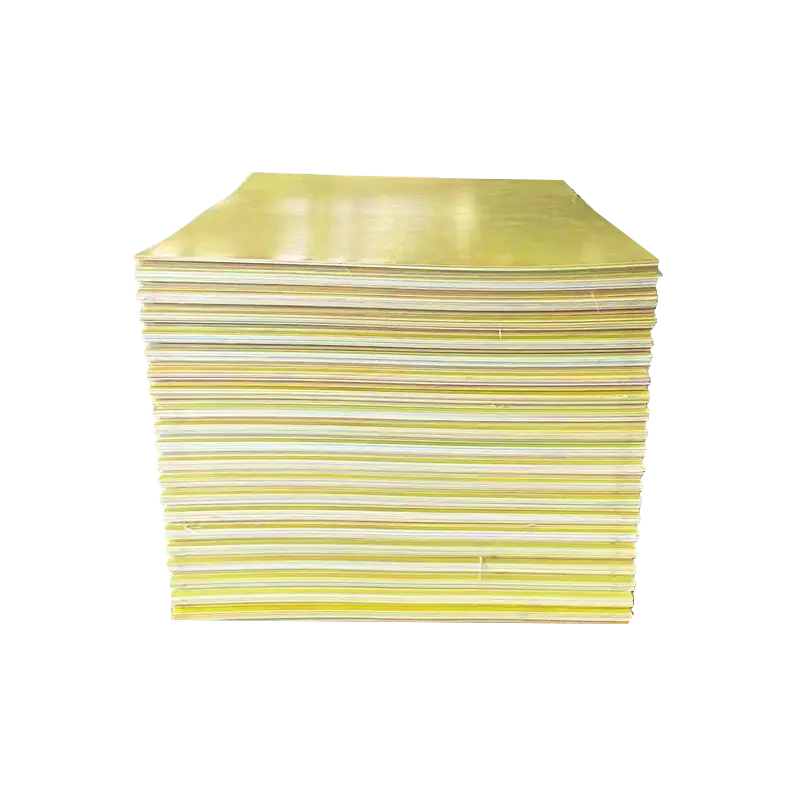
- Stacked panels with weighted cover plates resist moisture gradients better than vertical racks
- First-in-first-out inventory rotation limits the average storage time each panel spends absorbing humidity
A G10 epoxy board manufacturer that treats the warehouse as an extension of the press room ships panels that arrive flat and stay flat. One that ignores storage conditions ships panels that leave the factory flat and arrive curved, and the buyer never knows whether the warp originated in the press or on the pallet. The straightedge test answers that question, but by then the order has already been lost.
GET A QUOTE FOR COMPOSITE INSULATION PANELS.
-
 Phone
+86-0570-4939199
Phone
+86-0570-4939199
-
 E-mail
[email protected]
E-mail
[email protected]
Product Categories
About Company
Contact Us
- +86-0570-4939199/ +86-0570-4939188
- +86-13757003311/ +86-13906701423
- +86-13626705575
Company Address
-
 22-11 Lianhuashan Avenue, Lianhuashan Industrial Park, Jiangshan City, Zhejiang Province, China
Copyright 2025 Jiangshan Yongming Electrical Equipment Co., Ltd. All Rights Reserved.

Epoxy Board Manufacturer
